

Beneath the outer winding of the bass strings (E6, A5, D4, and in some cases G3), there exists a solid core wire that comes in one of two varieties: round core and hex core.
Refer to the diagram to observe their cross-sectional views.
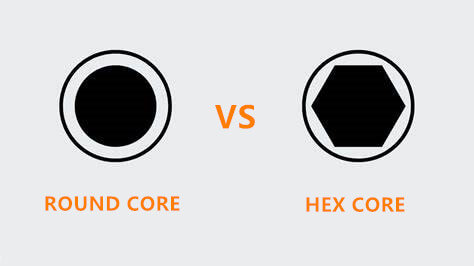
Initially, all guitar strings possessed round cores until D’Addario pioneered the creation of the first hex cores. Subsequently, it did not take long for hex cores to become the industry standard among almost all major manufacturers. This is primarily because the sharp edges of the hexagonal cores are adept at “gripping” the outer wire, thereby preventing slippage and enabling more accurate and consistent machine-winding. As a result, it is much more common nowadays to see round core strings being assembled by hand.
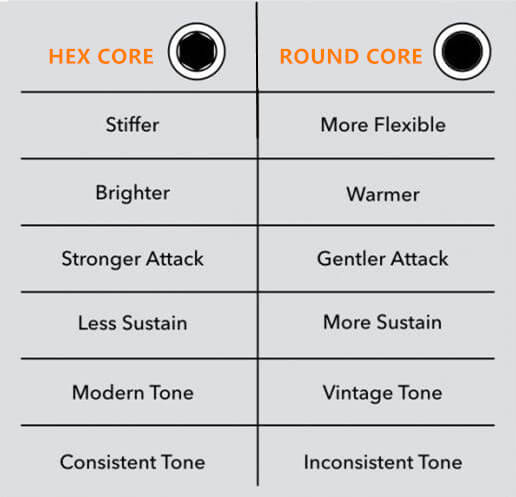
Now, let us examine how these two core types compare in terms of performance. Note: With round core strings, it is imperative to tune them up to pitch before trimming them. Otherwise, the outer wrapping will slip and unravel.
The wire that wraps around the solid core comes in 1 of 3 varieties:
- Roundwound – which uses a round wire to create a textured-surface string (shown in the diagram).
- Flatwound – which uses a flat wire to create smooth-surface string.
- Halfround – which is a hybrid of the previous two. Using techniques such as mechanical grinding (groundwound) or roller compression (rollerwound), the round wire is partially flattened, but not completely.
Of the 3, roundwounds are the most popular by far. They’re also the cheapest, with the widest selection to choose from.
Flatwounds are 2nd most popular, but are usually more expensive.
Halfrounds are the least popular, and you can pretty much disregard them when shopping for strings.
Now here’s how roundwounds and flatwounds compare in terms of performance: